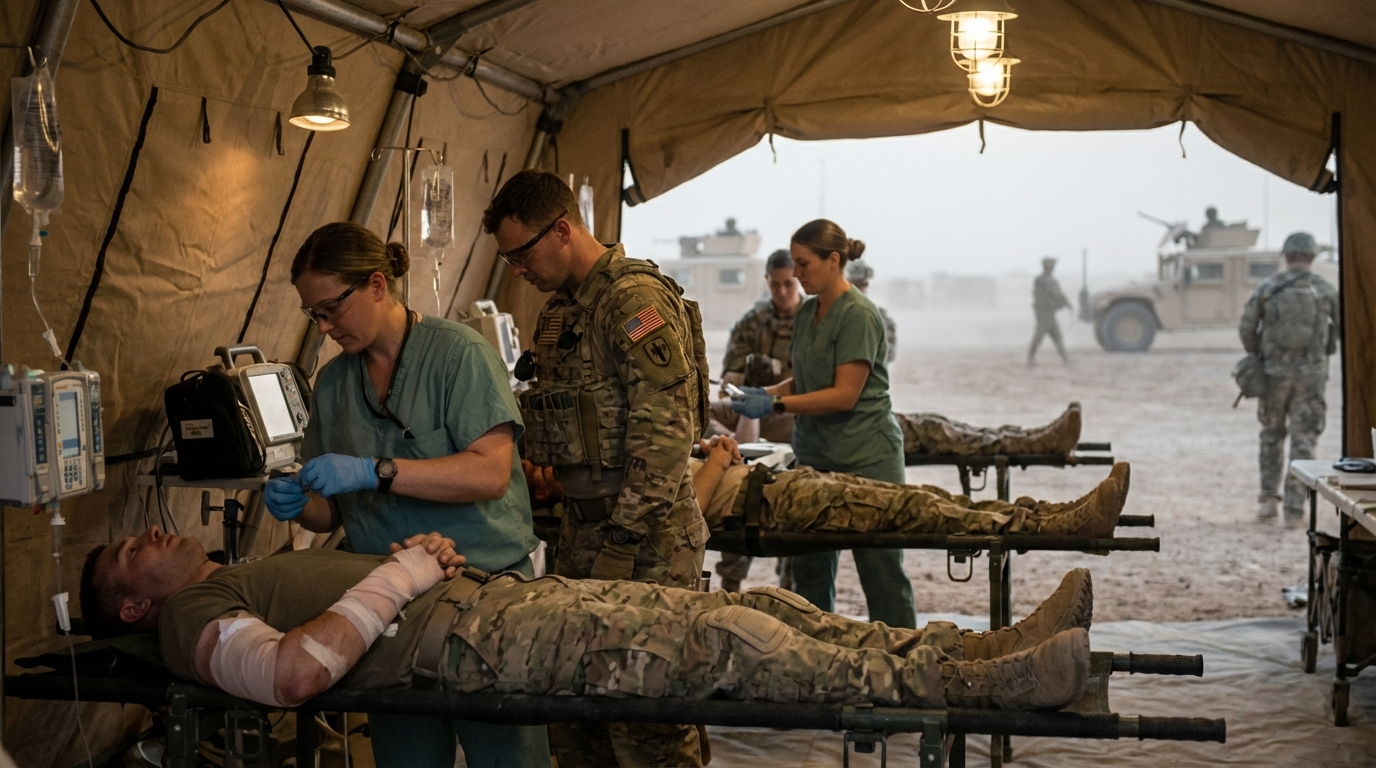
The US military has reported approximately 200 American service members wounded in the ongoing US-Israeli war on Iran, according to a statement from US Central Command (CENTCOM) [1]. This update comes as the conflict, designated 'Operation Epic Fury,' has also resulted in the deaths of 13 US service members and over 1,300 Iranians [1].
What Happened
- A US military spokesperson confirmed that approximately 200 US service members have sustained injuries in the US-Israeli war on Iran [1].
- US Central Command (CENTCOM) spokesperson Cpt Tim Hawkins communicated this figure, specifying that these casualties occurred since the initiation of "Operation Epic Fury" [1].
- Beyond the wounded, the conflict has also led to the deaths of 13 US service members and more than 1,300 Iranian individuals [1].
- In a separate but related development, the US Supreme Court announced it would consider arguments regarding the Trump administration's policy to terminate legal protection statuses for individuals from countries such as Haiti and Syria [3]. These individuals are seeking refuge from war and natural disasters [3].
- The conservative-majority Supreme Court, however, declined to immediately lift these protections on Monday, thereby allowing hundreds of thousands of people to maintain their legal status to live and work within the United States for the present [3].
- Concurrently, Cuba experienced a national blackout following the collapse of its electric grid, an event occurring amidst a sustained US oil blockade [8].
Why It Matters
The latest report of 200 US service members wounded in the US-Israeli war on Iran, alongside 13 US fatalities and over 1,300 Iranian deaths, underscores the significant and ongoing human cost of "Operation Epic Fury" [1]. These figures indicate a sustained level of military engagement and highlight the potential for further escalation in a critical geopolitical region [1]. The cumulative casualty count suggests that the conflict is far from resolved and continues to demand substantial resources and personnel from the involved parties.
The strategic importance of the Strait of Hormuz, a key maritime passage, remains a point of international focus amidst the broader regional tensions [6]. Questions persist regarding which nations or entities are responding to calls for assistance or engagement in securing this vital waterway, indicating ongoing concerns about maritime security and freedom of navigation [6].
The US Supreme Court's decision to review the Trump administration's efforts to end Temporary Protected Status (TPS) for individuals from war-torn nations like Syria and disaster-affected Haiti reflects the complex interplay between international conflict, humanitarian crises, and domestic immigration policy [3]. While the court has temporarily preserved protections for hundreds of thousands, the ultimate outcome could significantly impact displaced populations seeking safety and stability in the United States [3].
The national blackout in Cuba, attributed to the collapse of its electric grid amid a US oil blockade, illustrates the severe economic and humanitarian consequences that can stem from prolonged international sanctions and economic pressure [8]. Such events can destabilize national infrastructure, exacerbate living conditions, and potentially fuel broader social unrest, demonstrating the far-reaching impacts of geopolitical tensions beyond direct military confrontation [8].
Signals To Watch (Next 72 Hours)
- Any further official statements or detailed operational updates from US Central Command regarding the progress or casualty figures of "Operation Epic Fury" in Iran [1].
- Diplomatic initiatives or military posture adjustments by the United States, Israel, or Iran, particularly concerning the Strait of Hormuz [1, 6].
- The schedule and arguments presented during the US Supreme Court's review of the Trump administration's policy on protection statuses for Haitian and Syrian nationals [3].
- International reactions or potential interventions concerning the humanitarian situation in Cuba following the national blackout and ongoing US oil blockade [8].
- Any public statements from the Trump administration clarifying its stance on the Supreme Court's deliberation or the Cuban blockade [3, 8].
- Reports on the timeline for the restoration of Cuba's national electric grid and the immediate impact on its population [8].
- Monitoring for any shifts in rhetoric or policy from key regional or international actors regarding the US-Israeli war on Iran [1].
Westbridge Intelligence will continue to monitor these developments.
Sources
- At least 200 American troops wounded in Iran war, US military says — Guardian World · Mar 16, 2026
- Supreme court to consider Trump push to end protection status for Haitians and Syrians — Guardian World · Mar 16, 2026
- Who is answering Trump’s call for help with Strait of Hormuz? — Al Jazeera · Mar 16, 2026
- Cuba electric grid collapses amid US oil blockade causing national blackout — Al Jazeera · Mar 16, 2026