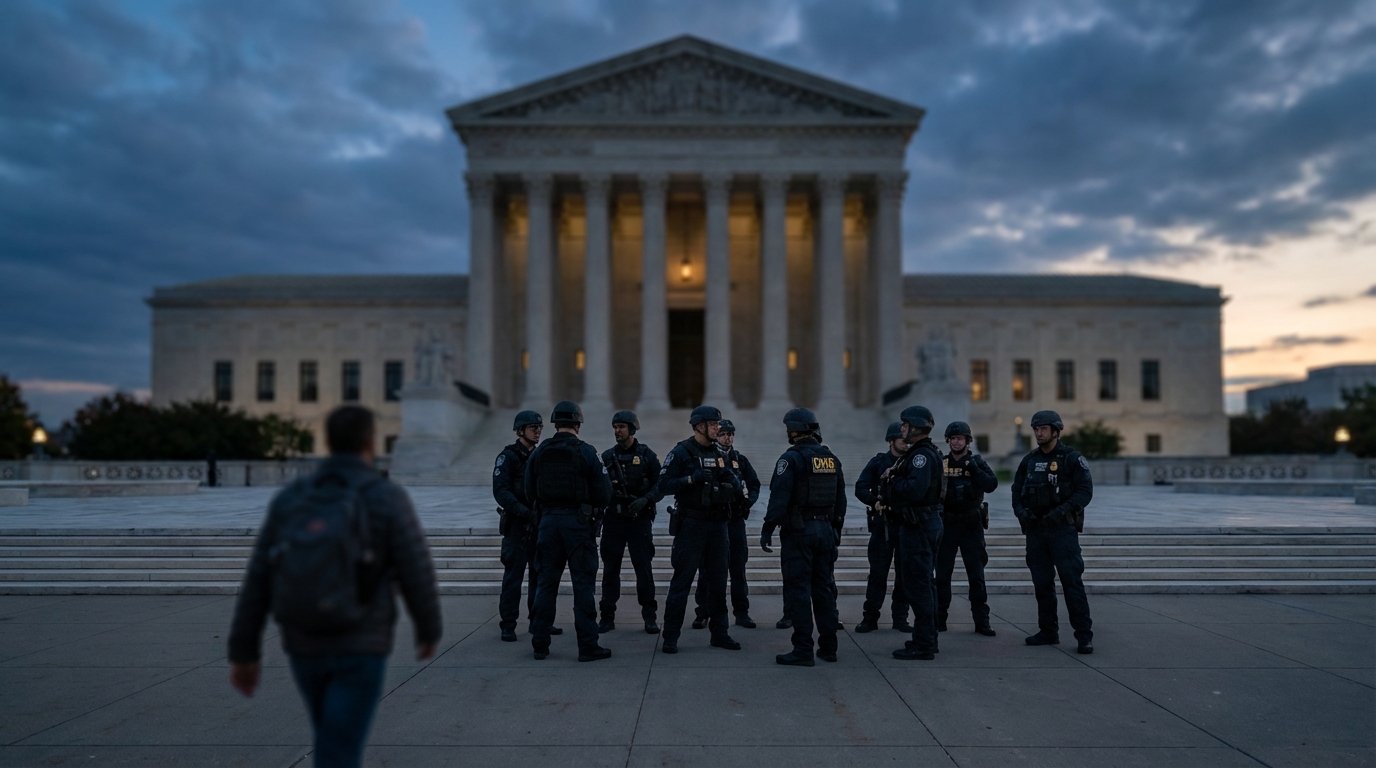
The United States is currently navigating significant developments across its legal, security, and social landscapes. The Supreme Court has intervened in a critical immigration matter, temporarily blocking the deportation of approximately 6,000 Syrians and 350,000 Haitians who possess Temporary Protected Status (TPS), indicating an expedited review of the administration's stance [1]. This legal challenge unfolds as federal immigration agents increasingly adopt a tactical appearance, including body armor, helmets, and camouflage, prompting scrutiny regarding the operational posture of domestic enforcement [5].
What Happened
- The United States Supreme Court has temporarily blocked the Trump administration from deporting approximately 6,000 Syrian and 350,000 Haitian nationals who hold Temporary Protected Status (TPS) [1]. The court has scheduled expedited arguments to review the legality of the administration's actions regarding these protected statuses [1].
- Federal immigration agents, specifically those from Immigration and Customs Enforcement (ICE), have been observed operating in what is described as a militarized appearance, featuring body armor, helmets, and camouflage clothing [5]. This operational shift has drawn comparisons to the attire typically worn by elite military special operators [5].
- The U.S. Defense Department formally released the identities of six Air Force service members who tragically died when their military refueling aircraft crashed on Saturday [2]. The incident represents a significant loss for the Air Force [2].
- In Alaska, state wildlife managers have initiated a controversial program involving the culling of predators, including grizzlies and wolves, as a measure to counteract the declining population of caribou [6]. This intervention aims to support the recovery of caribou herds [6].
- A new technological solution, dubbed the "PFAS Annihilator," has been developed to effectively destroy per- and polyfluoroalkyl substances (PFAS) present in firefighting foam [4]. These "forever chemicals" have been linked to various health issues, including cancer [4].
- Team USA achieved a notable performance at the recent Paralympics, securing the second-highest number of medals overall with a total of 24, including 13 gold [7]. A highlight was the U.S. sled hockey team's victory over Canada, earning their fifth consecutive gold medal [7].
Why It Matters
The Supreme Court's intervention in the Temporary Protected Status (TPS) cases for Syrian and Haitian nationals highlights the profound legal and humanitarian implications of U.S. immigration policy [1]. The decision to temporarily halt deportations and schedule expedited arguments signals the judiciary's recognition of the immediate impact on hundreds of thousands of individuals and the broader legal framework governing humanitarian protections. The outcome of these arguments will not only determine the fate of current TPS holders but also establish significant precedents for how future administrations can manage or terminate such statuses, influencing international relations and domestic social stability.
The observed change in the operational appearance of federal immigration agents, characterized by the adoption of body armor, helmets, and camouflage, introduces a new dimension to domestic law enforcement [5]. This shift raises critical questions about the perceived role of agencies like ICE and the potential for increased public apprehension or confrontation. While proponents might cite agent safety as a rationale, critics argue that such militarization could exacerbate tensions within communities, particularly those with significant immigrant populations, and further blur the distinctions between civilian policing and military-style operations. The long-term implications for civil liberties and community trust warrant close monitoring.
Beyond these immediate policy and enforcement discussions, other national developments underscore the diverse challenges and achievements within the United States. The tragic loss of six Air Force airmen in a military refueling aircraft crash serves as a somber reminder of the inherent risks faced by service members and the ongoing demands placed on the nation's defense apparatus [2]. In environmental policy, Alaska's predator control program to save caribou populations illustrates the complex and often contentious nature of wildlife management, balancing ecological interventions with conservation ethics [6]. Furthermore, the introduction of the "PFAS Annihilator" offers a promising development in addressing widespread environmental contamination from "forever chemicals" in firefighting foam, presenting a potential path to mitigate significant public health risks associated with cancer and other illnesses [4]. On a more celebratory note, Team USA's strong performance at the Paralympics, securing 24 medals, including a fifth consecutive gold for the sled hockey team, showcases national resilience and athletic excellence on the global stage [7]. These varied events collectively reflect a nation grappling with complex internal dynamics and demonstrating diverse capacities.
Signals To Watch (Next 72 Hours)
- Further statements or legal filings from the Supreme Court regarding the expedited arguments on Temporary Protected Status [1].
- Public or governmental reactions to the Supreme Court's temporary block on deportations for Syrian and Haitian TPS holders [1].
- Any official statements or policy clarifications from ICE or the Department of Homeland Security regarding the operational attire of federal agents [5].
- Updates on the investigation into the military refueling aircraft crash that resulted in the deaths of six Air Force airmen [2].
- Continued public discourse or policy discussions in Alaska concerning the predator control program aimed at saving caribou populations [6].
- Reports or announcements regarding the deployment or broader adoption of the "PFAS Annihilator" technology for environmental remediation [4].
- Media coverage or public commentary reflecting on Team USA's performance and individual athlete achievements at the Paralympics [7].
These concurrent developments underscore a dynamic period for policy, security, and societal narratives within the United States.
Sources
- Supreme Court to hear expedited arguments on protected status for migrants — NPR National · Mar 16, 2026
- Here are the names of the 6 Air Force airmen who died when their refueling plane crashed — NPR National · Mar 16, 2026
- A new tool is helping to annihilate dangerous PFAS in firefighting foam — NPR National · Mar 16, 2026
- Why ICE agents are wearing body armor, helmets and camouflage clothing — NPR National · Mar 16, 2026
- In Alaska, wildlife managers are killing grizzlies in an attempt to save caribou — NPR National · Mar 16, 2026
- Team USA won the second-most medals at these Paralympics. See the standout moments — NPR National · Mar 16, 2026