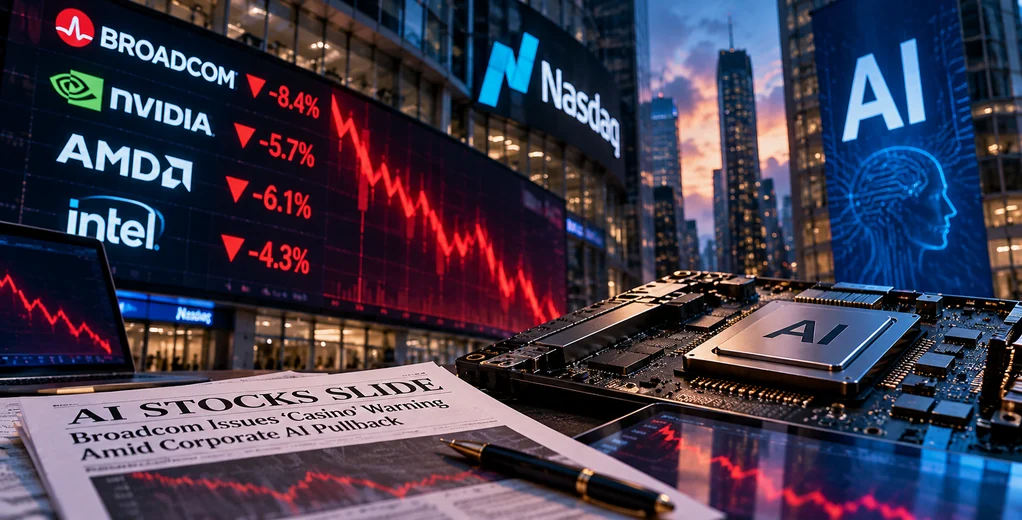
The financial markets are currently characterized by a notable divergence in sector performance, with the semiconductor industry officially entering a bear market [6]. This significant shift occurs concurrently with a robust boom in the energy sector and a period of strength for the average stock, collectively indicating a complex yet potentially healthy broader market environment despite specific industry headwinds [5, 3].
What Happened
- The semiconductor sector has officially entered a bear market [6].
- This downturn in chip stocks is characterized as a sector reset, with a noted tendency for underperformance during the third quarter [6].
- A Bank of America analyst has advised investors against panic regarding the current state of chip stocks [6].
- Energy companies are experiencing a significant boom in their performance [5].
- The average stock on Wall Street has demonstrated positive momentum, which is viewed as an indicator of a healthy market, even amidst struggles in the semiconductor industry [3].
- Moonshot AI has introduced its new open model, Kimi K3, which is reportedly catching up to leading AI developers such as Anthropic and OpenAI, raising questions about the future competitive landscape in artificial intelligence [2].
- The winning side of the World Cup is set to receive $50 million in prize money, a portion of which will be subject to taxation by the IRS [1].
Why It Matters
The pronounced divergence in market performance, particularly the semiconductor sector's official entry into a bear market, signals a significant re-evaluation of growth narratives within equities [6]. While chip stocks have historically been bellwethers for technological advancement and economic expansion, their current underperformance, especially noted as a tendency in the third quarter, suggests investors are recalibrating expectations for future earnings and valuations [6]. This shift could prompt a broader re-allocation of capital, moving away from previously high-flying tech segments towards sectors demonstrating more immediate strength or perceived value.
Conversely, the robust performance of energy companies presents a compelling counter-narrative, indicating resilient demand or favorable pricing dynamics within the global energy markets [5]. This sector's boom provides a crucial offset to the tech downturn, highlighting the cyclical nature of market leadership and the importance of diversification. The simultaneous strength observed in the "average stock" further reinforces a potentially healthier market environment, suggesting that gains are not solely concentrated in a narrow band of mega-cap companies but are instead distributed across a wider array of equities [3]. This improved market breadth is often interpreted as a sign of underlying economic stability and broader investor confidence, even amidst specific sector-level challenges.
The intensifying global competition in artificial intelligence, exemplified by Moonshot AI's new Kimi K3 model catching up to established players like Anthropic and OpenAI, introduces another layer of complexity to the technology landscape [2]. This development could reshape the competitive dynamics within the AI industry, influencing investment flows, partnership strategies, and the long-term viability of current market leaders. The rapid pace of innovation in AI means that the competitive advantage can be fluid, requiring continuous monitoring of new entrants and their capabilities.
Signals To Watch (Next 72 Hours)
- Further price action and trading volumes in key semiconductor indices, such as the Philadelphia Semiconductor Index (SOX), to assess the depth and duration of the current bear market [6].
- Performance of major energy sector exchange-traded funds (ETFs) and individual oil and gas producers for continued upward momentum or signs of consolidation [5].
- Updates on market breadth indicators, including the percentage of stocks above their 200-day moving average, to confirm the sustained strength of the average stock [3].
- Any new product announcements or strategic partnerships from Moonshot AI or its competitors, Anthropic and OpenAI, that could signal shifts in the AI competitive landscape [2].
- Global macroeconomic data releases, particularly those related to industrial production or energy consumption, which could impact both semiconductor demand and energy prices [5, 6].
- Analyst revisions for earnings estimates in both the semiconductor and energy sectors, reflecting updated outlooks based on recent performance trends [5, 6].
- Investor sentiment surveys or institutional flow data to identify any significant shifts in allocation preferences between growth-oriented technology and value-oriented energy sectors [3, 5, 6].
These dynamics underscore a complex market environment requiring careful sector-specific analysis.
Sources
- The World Cup–winning side will make $50 million — and the IRS gets a cut — MarketWatch · Jul 17, 2026
- Meet Kimi K3, the newest Chinese AI model haunting Silicon Valley — MarketWatch · Jul 17, 2026
- The average stock is having a moment as semiconductors struggle. It’s a sign of a healthy market. — MarketWatch · Jul 17, 2026
- Look on the bright side: Energy companies are booming — MarketWatch · Jul 17, 2026
- Chip stocks have entered a bear market. A BofA analyst says not to panic. — MarketWatch · Jul 17, 2026